
The Simple 3-Fund ETF Portfolio
Most beginners think investing requires:
- picking the perfect stock
- predicting the market
- watching financial news every day
In reality, long-term wealth is usually built in a much quieter way.
It comes from simplicity, consistency, and time.
One of the most proven beginner strategies is the 3-fund ETF portfolio. It is a system designed to grow steadily. This happens without constant decision-making.
This guide walks you through that system step by step.
Why Simplicity Beats Stock Picking
The Simple 3-Fund ETF Portfolio for Beginners (Step-by-Step)
Stock picking feels exciting.
It also feels logical—find great companies, buy low, sell high.
But history shows a different truth:
- Most individual investors underperform the market
- Frequent trading often reduces returns
- Emotional decisions lead to buying high and selling low
Simplicity wins because it removes:
- guessing
- timing pressure
- emotional reactions
Instead of trying to beat the market, the 3-fund strategy focuses on owning the market.
Over long periods, that approach has quietly built wealth for millions of investors.
The 3-Fund Structure Explained
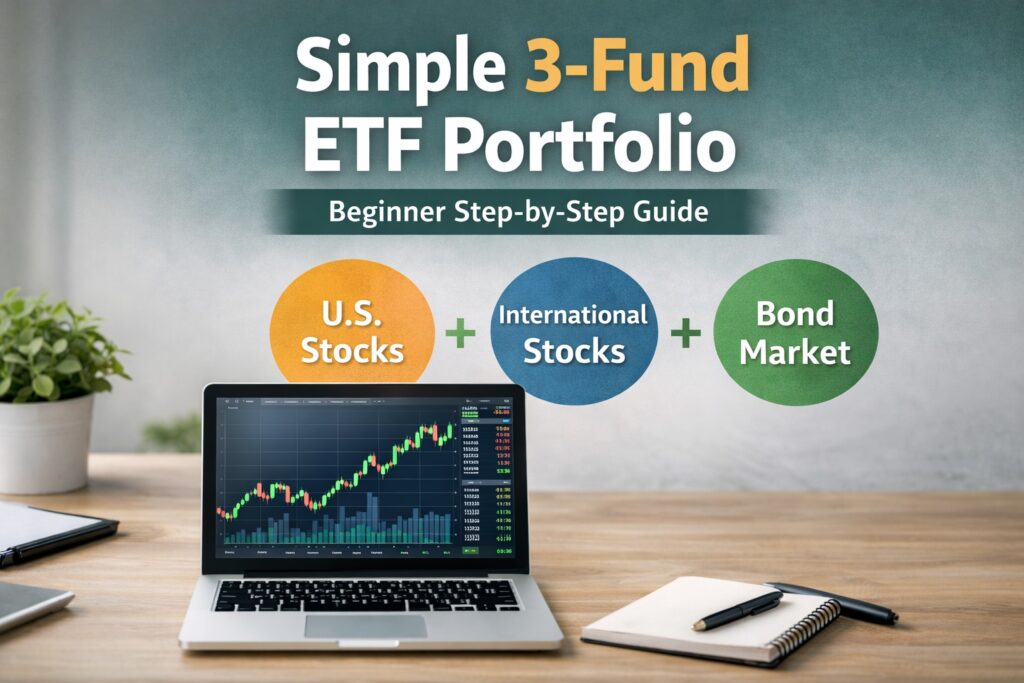
A traditional 3-fund portfolio holds:
- Total U.S. stock market ETF
- International stock market ETF
- Bond market ETF (optional for stability)
The Simple 3-Fund ETF Portfolio for Beginners (Step-by-Step)
Each fund plays a different role.
U.S. Total Market
Provides exposure to:
- large companies
- mid-size companies
- small businesses
This becomes the growth engine of the portfolio.
International Market
Adds diversification across:
- Europe
- Asia
- emerging markets
This protects you from relying on one country’s economy.
Bonds (Stability Layer)
Bonds don’t usually grow as fast as stocks.
Their purpose is different:
- reduce volatility
- cushion market downturns
- offer emotional stability during declines
Some younger investors choose 0% bonds,
while others prefer 10–30% for balance.
There is no single perfect percentage—only what helps you stay invested long term.
Example ETF Tickers and Allocations
Here is a simple beginner example:
Growth-focused (younger investors)
- 60% U.S. total market ETF
- 30% international ETF
- 10% bond ETF
Balanced approach
- 50% U.S. total market
- 30% international
- 20% bonds
Aggressive long-term
- 70% U.S. total market
- 30% international
- 0% bonds
The exact percentages matter less than:
- low costs
- broad diversification
- staying consistent for years
Complex portfolios rarely outperform disciplined simple ones.
How to Automate Monthly Investing
The real power of this strategy is automation.
Automation removes:
- hesitation
- emotional timing
- inconsistency
Instead of asking, “Is now the right time?”
it invests every single month.
Basic automation process
- Open a reliable brokerage account
- Deposit funds from your bank
- Set up automatic monthly transfers
- Buy the same ETFs on the same schedule
Over time, this creates:
- dollar-cost averaging
- habit-based investing
- steady compounding
You stop relying on motivation
and start relying on systems.
Common Mistakes Beginners Make
Even simple strategies fail when behavior gets in the way.
Here are the biggest mistakes to avoid:
1. Waiting for the “perfect time”
Markets are unpredictable.
Time in the market has historically mattered more than timing.
2. Changing strategy too often
Switching plans resets compounding
and increases emotional stress.
Consistency is more powerful than perfection.
3. Checking the market daily
Daily movement creates anxiety,
not better decisions.
Long-term investors think in years, not days.
4. Investing money needed soon
Short-term money should stay safe and liquid.
Investing is for long-term capital.
5. Stopping during downturns
Market declines are normal.
Stopping contributions during fear often hurts future returns.
The investors who stay consistent
are usually the ones who gain most from recovery.
The Quiet Power of Long-Term Compounding
The 3-fund portfolio is not exciting.
It does not promise overnight wealth.
What it offers instead is:
- clarity
- discipline
- long-term growth potential
Over many years, small monthly investments can grow into:
- meaningful savings
- financial flexibility
- real freedom of choice
Not through luck.
Through time and consistency.
Your Next Step
If you’re ready to start, the simplest first move is opening a reliable brokerage account and setting up automatic investing.
How to get started with Charles Schwab:
- Visit the secure Schwab sign-up page
- Open a brokerage account using the guided process
- Deposit funds from your bank
- Start investing using simple, diversified ETFs
👉 Start your Schwab account here:
Charles Schwab Site:
Get the Automatic Investing Plan
To make this even easier, download the free guide:
The 12-Month Automatic Investing Plan
Inside, you’ll see:
- the exact monthly system
- simple allocation examples
- the habit that builds long-term wealth
[Insert email signup or download link]
Final Thought
Wealth is rarely built through dramatic moves.
More often, it grows quietly in the background—
through simple systems repeated over time.
The 3-fund portfolio is powerful not because it is complex,
but because it is consistent.
Start simple.
Stay steady.
Let time do the heavy lifting.
Support Hunter of Money — Build Freedom Tools for Everyday People
I constantly spent my half an hour to read this weblog’s articles everyday along with a cup of coffee.